
Key takeaways
- Records aren’t context. Your systems hold facts about people. Decisions require an understanding of people, and that gap is where talent decisions go wrong.
- Context is the AI-era differentiator. Models are everywhere. A living picture of your workforce is not.
- It’s proven where it’s hardest. The Employee Graph drives matching at large enterprises today, at a scale where hand-pairing and form-matching both break down.
- Matching is the first query, not the last. Mobility, succession, staffing and community all draw on the same layer.
- It compounds. Every relationship enriches the graph, and the advantage grows with use.
What is an Employee Graph?
An Employee Graph is a living context layer for your workforce. It sits above the systems you already run, such as your HRIS, your ATS and your learning platform, and brings their signals together into one connected picture. Then it adds what no system of record captures: what actually happens inside real development relationships, and what intrinsically drives each person.
It isn’t another system of record, and it doesn’t replace the ones you have. What it delivers is a decision, explained: a grounded recommendation with a clear reason, whether that’s the right connection, the right move or the right moment.
Why do talent decisions need more than HR data?
Consider what your organization actually knows about one employee. Her HR record shows a title, a hire date and a department. Her learning history shows completed courses. Her resume, frozen at the moment she was hired, shows where she has been.
What none of those systems show: she has quietly become the person three teams go to for hard problems. She wants to move from engineering into product. She grew more from one mentoring relationship last year than from every course she completed. Her manager knows some of this. Her mentor knows more. No system knows it all.
Now multiply that by ten thousand employees. The knowledge that should drive your most important people decisions is scattered across systems that don’t talk to each other and locked in people’s heads. The cost shows up everywhere:
- Mentorships that fizzle because the pairing was superficial
- Internal candidates overlooked for roles they were ready for
- High-potential employees who leave because no one connected them to their next chapter
- Programs that treat every employee as a form to be filled rather than a person in motion
Why does context matter more in the AI era?
AI can now read a career aspiration written in plain language, weigh dozens of compatibility signals at once and explain its reasoning in a way a person can evaluate and trust. But the model is only as good as the context it is given. Point the most capable AI in the world at a stale profile and a job title, and you get a confident-sounding version of a guess.
The models themselves are broadly available. Every vendor uses them. What is scarce, and what can’t be bought off the shelf, is a live understanding of who your people are, how they are growing and how they relate to one another.
The organizations that win won’t have the cleverest algorithm. They’ll have the richest understanding of their people for the algorithm to reason over.
What goes into an Employee Graph?
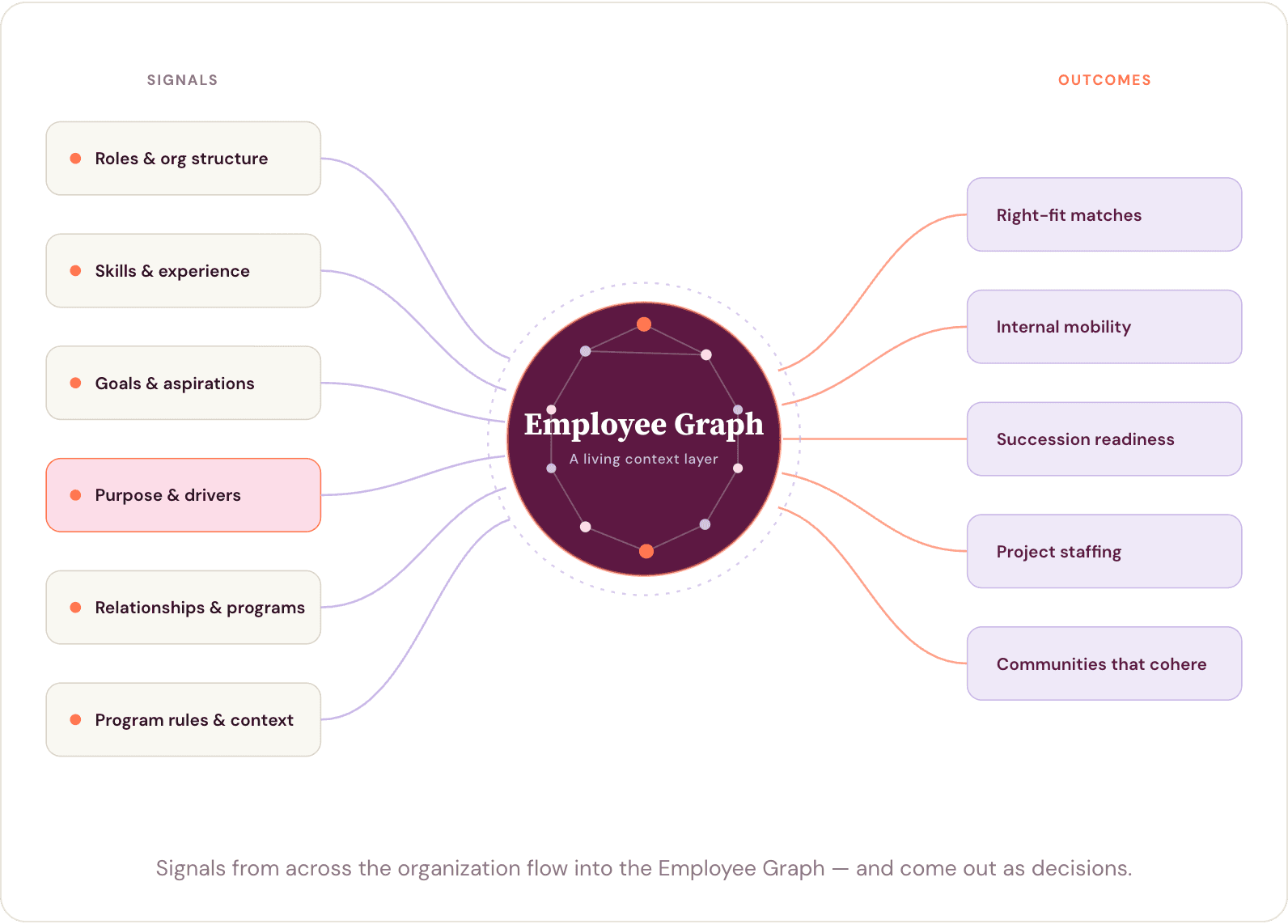
For every match, the Employee Graph draws on a connected picture assembled from across the organization:
- Who the person is: role, function, level, location, language and tenure, drawn from the systems you already maintain.
- What they bring: skills, competencies and experiences, both declared and demonstrated across programs.
- What they want: career goals, development areas and stated preferences, expressed in their own words rather than forced into rigid checkboxes.
- What drives them: each person’s purpose profile: who they seek to impact, why work feels meaningful to them and how they instinctively create value.
- How they connect: program participation, current and past mentoring relationships, communities joined and the outcomes of those connections.
- What the program needs: the rules of engagement your administrators define, such as who is eligible for whom, capacity limits, organizational boundaries and the goals of the program itself.
Purpose: the signal beneath every other signal
With the acquisition of Imperative, Chronus brought a research-backed Purpose Assessment into the platform, a validated instrument that reveals what intrinsically drives each person at work. Titles tell you what someone does. Skills tell you what they can do. Purpose tells you why they do it.
In the Employee Graph, purpose is the deepest layer. It is data no HR system holds and no resume reveals, and it turns matching from pairing profiles into connecting people.
How is an Employee Graph different from your HR systems and skills tools?
Most talent data describes what a person has already done. The Employee Graph is built to understand where a person is headed, and who they lean on to get there.
| Source | What it tells you |
|---|---|
| Your HR systems | Structured facts: title, tenure, courses completed. Essential, but static. |
| Skills tools | Inferred from resumes and job descriptions. Still a snapshot of the past. |
| The Employee Graph | Living and relationship-derived: what a person is becoming, and who they trust. |
How does an Employee Graph improve matching?
The Employee Graph is the engine behind Chronus matching at some of the world’s largest enterprises today, in mentoring, career development and community programs across geographies, business units and time zones.
At that scale, matching is an unforgiving test. A program with fifty people can be paired by hand. A global program with fifty thousand cannot. Eligibility, capacity, preferences, fairness and timing all have to be handled by the platform, and every recommendation has to be one that a program administrator can stand behind and an employee can trust.
How enterprises put it to work
- Administrator-led matching at scale. Program admins pair hundreds or thousands of participants in bulk, with the graph scoring every candidate pairing and surfacing the strongest options first. What used to be a spreadsheet marathon becomes a review-and-approve workflow.
- Self-directed discovery. Employees browse and choose their own mentor or connection, with candidates ranked by genuine compatibility rather than alphabetical order.
- Hybrid models. The graph proposes, employees express preferences and administrators confirm, keeping people in control while removing the guesswork.
- Guardrails built in. Every recommendation respects reporting-line exclusions, business-unit boundaries, capacity limits and program eligibility. The graph works within your governance, not around it.
What an employee actually sees
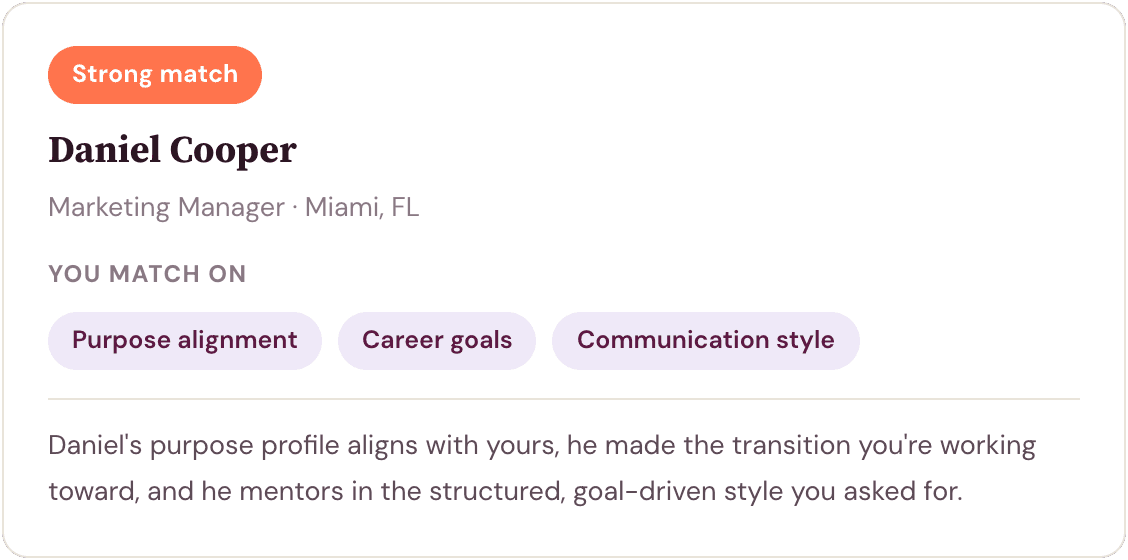
Every recommendation is explainable. Instead of a mystery score, employees and administrators see the dimensions behind the match, such as shared goals, complementary experience and aligned expectations. The recommendation earns trust instead of demanding it.
Why it works better than form-matching
Traditional matching tools compare questionnaire answers and stop there. The Employee Graph connects profile data with program context and live relationship signals, so it produces matches that hold up in the real world.
| Form-based matching | Employee Graph matching | |
|---|---|---|
| Inputs | One form, filled once | Profile, goals, skills, program context and relationship history, continuously updated |
| Goals | Fixed checkboxes | People’s own words, interpreted in context |
| Basis for pairing | Surface similarity | Compatibility and growth, including the person a step ahead on your path |
| Depth of signal | What people say on a form | What actually drives them: a validated purpose profile alongside goals and skills |
| Reasons | A score, unexplained | Every match shows what it’s based on |
| Over time | Static: the same on day 500 as day one | Learns from real outcomes, and every cycle improves the next |
| At enterprise scale | Manual review bottlenecks | Bulk matching in minutes, with governance built in |
Where does matching go next?
The matching running at enterprises today is the foundation. As the Employee Graph deepens, the match itself keeps evolving, from a great pairing at a point in time to an intelligence that accompanies the whole relationship. It will suggest the right person before someone thinks to ask, at moments of transition, new goals or new roles. And because relationships evolve, it will know when one has run its course and when to introduce something new.
What else can an Employee Graph do?
Matching is the beginning, not the boundary. The same intelligence that powers a great match answers the next questions too, with no new system and no new data entry.
- Internal mobility. Show people the moves that fit their trajectory, and show you the talent you already have for the role you’re trying to fill, including the people no keyword search would surface.
- Succession and readiness. See who is genuinely ready for what’s next, grounded in demonstrated growth and relationships rather than tenure and title alone.
- Sponsorship and staffing. Connect the right people to the right projects and advocates, based on capability, aspiration and complementarity.
- Community. Form mentoring circles, cohorts and employee communities that actually cohere, because they’re built from a real understanding of your people.
Why does an Employee Graph get better over time?
An Employee Graph is not a one-time setup. Every mentoring conversation, every goal met and every relationship that forms or concludes adds to it. The more your organization grows and connects, the sharper every recommendation becomes.
This is also why it can’t be replicated by pointing an AI at your HR data. The richest signal in it, what actually happens inside development relationships, only exists where those relationships are formed, guided and measured. That is the layer Chronus runs.
Frequently asked questions
Does an Employee Graph replace our HRIS?
No. It isn’t another system of record, and nothing gets ripped out. It works alongside your HRIS, your ATS and your learning platform, and brings their signals together.
Is the Employee Graph available today?
Yes. It powers intelligent matching for large enterprises on Chronus today, connecting employees across mentoring, career development and community programs worldwide.
What is a purpose profile?
A purpose profile comes from the research-backed Purpose Assessment Chronus gained with the acquisition of Imperative. It shows who a person seeks to impact, why work feels meaningful to them and how they instinctively create value.
Can employees see why they were matched?
Yes. Every match shows what it’s based on, such as shared goals, complementary experience and aligned expectations.